Tuesday, March 21, 2017

Las Fallas of Valencia

No, that does not say phallus. Las Fallas (pronounced like fa-yahs) is a celebration that occurs throughout the week leading up to March 19 held in Valencia and surrounding towns in Spain. People create (and sometimes spend an entire year) building these huge colorful, beautiful, and detailed sculptures that go on display throughout the city. In the past they were made from wax covered with cloth until recently when the artists started to use a paper "concrete" built up around a wooden frame. They are technically called ninots, which is Catalán for doll (Catalán is one of the four major languages spoken in Spain. Ha, bet you thought everyone in Spain spoke Spanish. Nope. ;D) Some are a few feet tall, others can be upwards of 8 whole stories. And knowing that they were created by hand makes it so much more awe-inspiring. Here are some of the pictures of the ninots from this year.


This was one of the largest ninots, at about 7-8 stories.


This was the largest of the fallas, at about 10 stories


When I first got off the bus in Valencia there was a huge crowd of people waiting for the yearly daytime fireworks show to start at 2 pm, and it was hard to get a good spot, and I ended up just barely around the corner of a building, so I wasn't really able to see them well. Which wasn't a problem really, because these fireworks weren't the colorful kind, they were purely for sound. Let me tell you one thing, Spaniards know how to do their fireworks. Although it is a little bit more... unsafe than in the States just because of the proximity of the people to the launch area, but that's not too big of a deal. Anyways, this was the loudest. fireworks display I have ever heard in my life. I video recorded the ending when it was super loud, but the camera can't do it justice. After the end there was so much smoke that you couldn't even see through it until a few minutes later when it started to clear out and left most of the downtown area covered in a thick haze for like 10 minutes. Crazy stuff.

And speaking of fireworks, there were fire crackers. Lots and lots of firecrackers. Little kids, teens, and adults all had bags/boxes of firecrackers and they would walk around the city randomly lighting them. There was literally not a silent moment, it was a constant barrage of firecrackers. And not all of them were your average tame firecrackers mind you... some of these suckers were the size of D batteries and left you half deaf after they exploded. There was a particularly annoying group of little kids that actually threw firecrackers at Alisa and me while we were trying to sit having lunch, and Alisa actually got burned a little by one of them, or was at least hit with its shrapnel. I ended up yelling at them to go to hell, knowing they probably wouldn't understand me because I was too mad to Spanish.

Anyways, back to the ninots. They were soooo beautiful, and the paintwork on some of them was just unbelievable. Everyone's (least) favorite fascist even made a few appearances.

To the right, out of frame, is a scene representing the Brexit, and a caption underneath Trump reads: Riding his golden float, Trump enjoys the show of the European debacle, which doesn't matter to him at all.

This one I can't translate; anyone know Catalán?

The very small sign next to his right leg reads:
Instructions to build the wall:
1 - Buy the world's supply of bricks
2 - Make México pay for it
3 - Make Mexican workers build it

He's basically the laughingstock of the world. Seeing how much time people spend making these, it would be a huge shame if something happened and they broke. Or worse, get burned down by some drunk and their lighter. But, that's exactly what happens. Minus the drunk. Surprise! The whole point here is to burn the ninots after they go on display. Didn't see that one coming, did ya? Yes it's sad, but so awesome at the same time. There is a large central ninot (the tall torch-looking one) that gets burned down at 1 am, and the smaller ninots get burned an hour before all at the same time, so you have to choose one of them to watch burn, and we chose the dragon. There was a lot of prep work before it went up in flames, but once it did it was over fast, and it got hot. Realllly hot. This ninot was about 4 stories tall and the crowd started no more than 8-10 yards away, which is where I was, and by the time I finished recording the majority of the burning, my hands were sooooo hot it was hard to keep going, but it was so awesome.

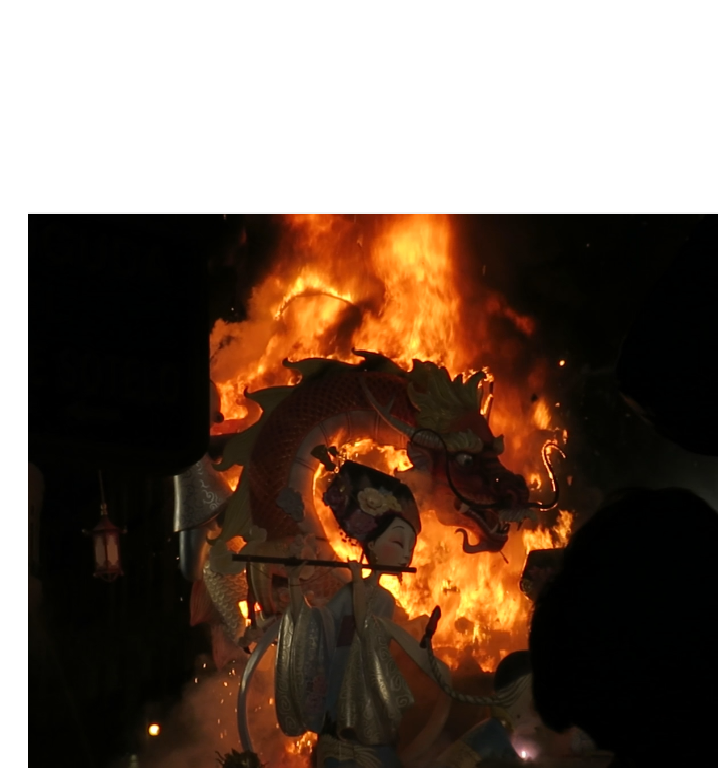
Then after that the big one in the center of the Plaza del ayuntamiento (the central government square) went up in flames after a lengthy pyrotechnic display, but even 100 yards away you could feel the heat.


What used to look like a big wooden torch

All in all it was a crazy night, but really sweet at the same time. I definitely wouldn't go back again, just because I had to be up and out of the house for over 26 hours because I went on a trip with an exchange student travel company, and some parts were just a little too crazy. But it's definitely worth going to once. So, that's that, I hope you've enjoyed!


Tuesday, October 25, 2016

Valencia


During my first week in Spain I went on a mini vacation to Valencia, and I had a great time. Not being in the spirit of letting my blog sit idle while I’m away, I want to share some of my experiences abroad here, and try to keep at least a little bit of fiber arts content as well. The day after I arrived in Spain I went to Valencia for 5 days. While I was there I went to the beach a couple times, visited some museums, and got lost. A lot. Thankfully one of our hosts gave us a map on our third day, so we didn’t have much of that after that. The first of the museums I visited was a museum of ceramics. Before Chinese ceramics became big around the world, Valencia was well-known for its high-quality porcelain in the 1700s. That wasn’t too terribly interesting I have to admit. The stuff was beautiful, but it was all more or less the same stuff over and over again. But the next museum… whoaaa that was a cool one. It was the Valencian Ethnology Museum, and it showcased the history of the region of Valencia from the 1900s all the way back to the earliest evidence of humans in the area tens of thousands of years ago. The modern stuff didn’t interest me too much, but the prehistoric stuff was awesome. But I will mention that Spain was quite behind the US in terms of development in the middle of the 1900s. From pictures in the museum, I saw that most farm houses still has grass roofs in the 50s, and mud shingles in the 60s. Anyways, back to the cool stuff. It showcased hundreds of old stone tools, ranging from arrowheads, to knives, to stone carving tools. As you progressed through the museum it got closer to modern day as it went, and it was really cool being able to see how peoples’ tools progressed from bone to stone to copper, to bronze, to iron, etc. It also has fragments of cave carvings and cave drawings. So here are some pictures showing all of that good stuff.


One of my favorite displays was something so small it would have been really easy to overlook, and I almost didn’t read the description under it, but I’m glad I did. Any ideas about what it could be?


 A ceramic supported spindle whorl!

I was totally blown away that they had a whorl from the 3rd century BC on display there, and had an accurate description of it. I might start making replicas of it when I get back to the US! The caption reads: "This whorl, situated at the bottom of the spindle shaft facilitated the twisting of fibers during spinning. Somebody carved two figures into it. Its owner?"

Here are some other cool exhibits from the museum


A cave painting that was kept in an almost pitch black room to protect the paint from light degradation. I used a long exposure with a wide aperture and high ISO to capture the photo, not wanting to expose the artwork to the flash of my camera.


 A collection of small tools used to etch stone, which can be seen in the following photograph.


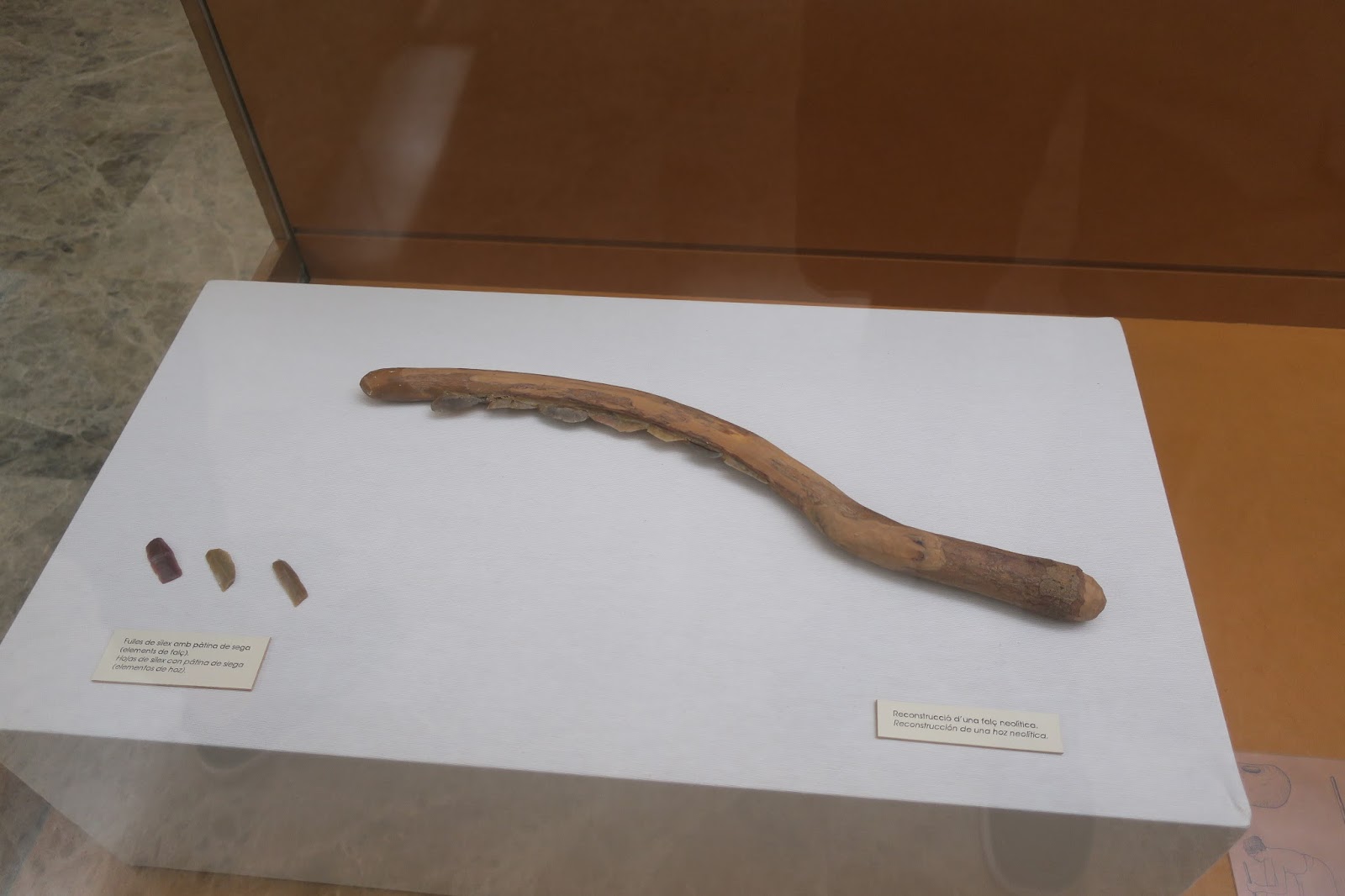
Who knew people made stone scythes?


Assorted flint knives


Now that's a dovetail...


Swords, with some Romanesque pottery
 

A stone axe head mold

Now I know I said the modern stuff didn't interest me too much, but there was one exhibit that caught my attention...

A little blurry, but I think you can all identify it :)
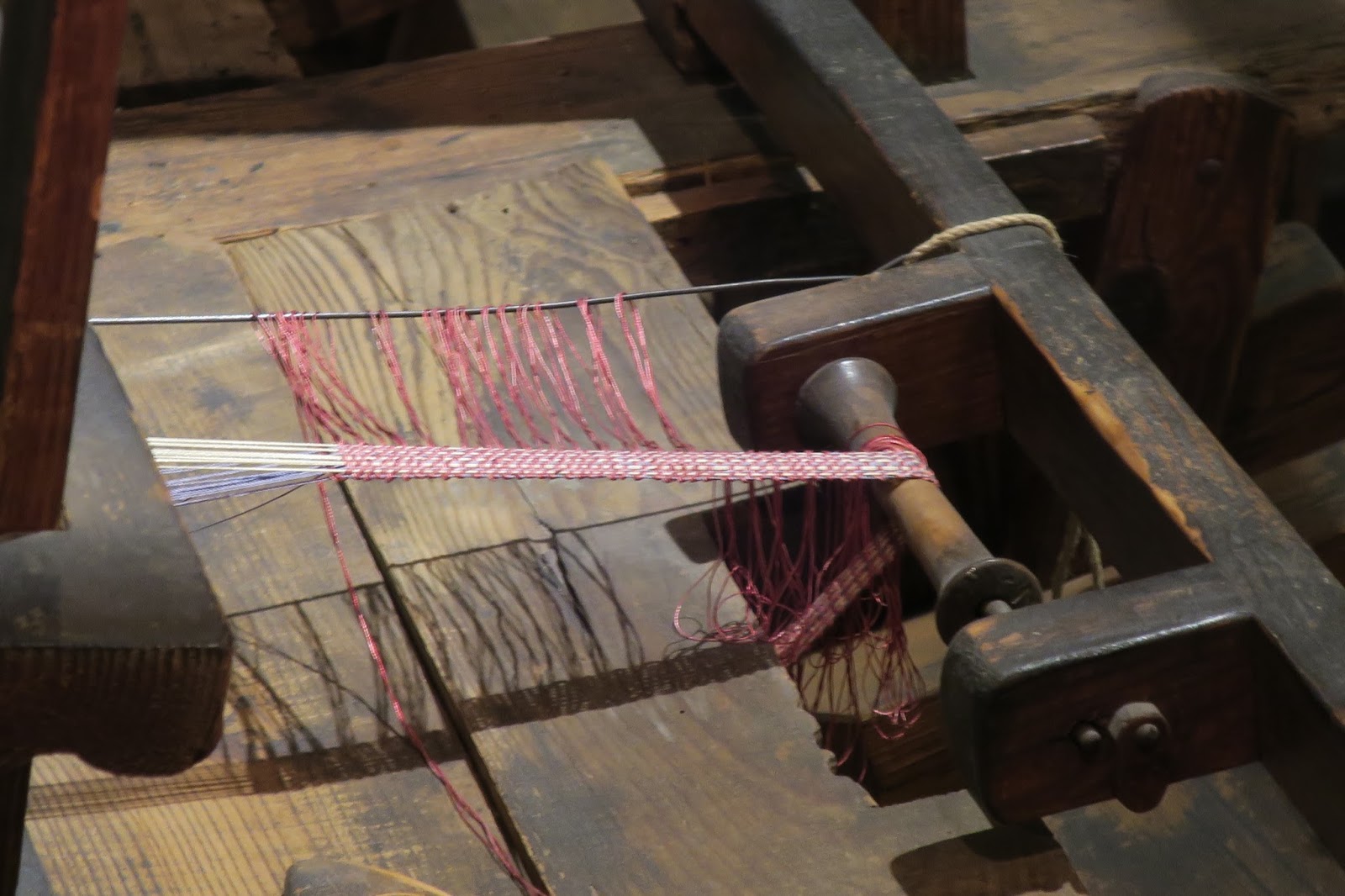
Quite a large loom

A zoom of the band that's woven on the loom. Although that wire off to the right of the work looks pretty out of place...


Another really awesome place we visited was the Botanical Gardens of the University of Valencia. I can’t begin to describe all of the cool plants (and cats) that were there, it was super pretty.

And the craziest thing we did was attend the annual Tomatina. The biggest tomato fight in the world, held in a nearby town called Buñol. Pure. Chaos. But it was so awesome at the same time. Imagine a narrow European street, with at least 30,000 people crammed into it, with over 300,000 pounds of tomatoes. That’s not a typo or an exaggeration, literally three hundred thousand pounds of tomatoes. There were 6 trucks that drove through the street with people throwing the tomatoes out, and every time a truck came by, the herders as I’m going to call them had to push everybody to the side of the street so there would be enough space for the trucks, and they pushed really hard to get everyone out of the way. And once the trucks went away there were tomatoes flying everyyyywhere possible. By the time the sixth truck came through, there was a good 6 inches of tomato juice sitting in the street, and some people, including myself, found cups or other containers to scoop up the tomato puree to fling in every direction possible. That madness lasted for an hour before we went on to try and find a place to get hosed off.

This post is a couple of months overdue, so hopefully I'll be able to catch up with the rest of them soon!

Thursday, June 30, 2016

Simplifying your Russian spindle spinning

Russian spindles are one of my favorite types of spindles. Not just because I'm attracted to all manner of foreign tools and techniques, but because I personally prefer to spin fine yarns. And spinning fine lace singles is what Russian spindles excel at doing. If you love to spin lace, you definitely need to try spinning on a Russian spindle.

So that brings to to the topic of this post, how to make handling and storing your cops a lot easier and with many fewer headaches. Once you have a full cop of singles spun on a Russian spindle, there's a cool little thing you can do. You can actually just grab hold of the cop and slip it right off the spindle, leaving yourself with a nice little wound of bundle of yarn to store or further process. But that nice tight little cop of yarn quickly starts to become a hassle which turns into a headache. The whole cop starts to loosen, becomes tangled at the ends and just generally starts falling apart and getting messy. And by the time to get to the center of your cop, the last 10-20 yards or so of yarn is just a scary mess. No bueno. So I had an idea to remedy this, and it turns out it works pretty nicely.

So without further hesitation, here we go. Things you'll need are a Russian spindle, available here, a piece of printer paper (I'm assuming notebook paper will work too), tape, and scissors. Nice and simple. What we're going to be doing here is simply making a paper cone that fits over the tapered body of our Russian spindles.

First, take a piece of paper and cut its length so that it comes down to the bottom of the body of your spindle, and stops an inch or two below the flicking point so you still have place to flick the spindle and store your temporary cop. Make this piece about 4 inches wide.

Before you actually start making the cone, cut 2 or 3 pieces of tape now, because your hands will be tied up in about 30 seconds. Position your paper as shown in the next photo, with the bottom left corner close to the bottom of your storage area, and the paper angled so the top left corner sticks out to the left.

Now take the top left corner over the front of the spindle, and start rolling the paper around the spindle tightly. The top of the cone has to be as tight as possible in order to make the paper cone grip your spindle. So you keep rolling...

And rolling... until the paper is completely rolled up, then you can secure it with tape.


Every once in a while the cone will slip and spin independently of the spindle. But as long as you rolled the top really tight, you can gently press it back down and it will stay there. So now, you just spin as normal, making sure to only wind your yarn on top of the cone, gently at first, just so you don't crush the cone against your spindle body.

 Then, once you're done spinning your cop, just slide the cone off and you're ready to store or rewind it to ply with! To help facilitate unwinding your cop, I suggest you find a thin metal bar, like from a metal clothes hanger, to slide your cone over so it spins freely while you are winding the yarn off of it.

Nice and tidy.

Happy spinning!


Monday, June 13, 2016

Hand Cards and Chess

I haven't had much to post about recently, unfortunately. I was planning on finally growing flax after missing out last year because of my trip to Puerto Rico. But... after 2 years of fallow, the grass was too thick to plow by hand, and I didn't have a rototiller or anything to till the land with, so I had to miss out again this year. And my cotton plants died... sadly. I planted them too early this year, and they were sort of stuck in their pots, way too large for them, because it was still too cold outside, and I wasn't able to build the mini greenhouse for them either. Lots of sad news this year. But hopefully sometime in the future when I'm actually in the United States for more than a year I'll try again.

But anyways, on to happier subjects. I did have a couple of special projects recently for two different friends. One was a chessboard. I made it from Hard Maple and Black Walnut with a little bit of plywood/MDF for the base and the baseboard for the checkered pieces. The outside got a coat of carnauba wax, but I went ahead and did a French polish on the top surface which turned out really nicely. And the other project was my first set of hand cards that I made. The carder heads were made out of soft/curly maple and given chamfered edges, with turned Ash handles. The carders were outfitted with 90 tpi carding cloth and finished with two coats of boiled linseed oil. I'll let the pictures do the rest of the talking now!